JFK:
A 50 Year Perspective
Of Our
Unrequited Idealism
Dedication: To the Class of 1964, Paramus High School, Paramus, New Jersey, & to the Class of 1968, Rutgers College, New Brunswick, New Jersey. We lived these years together.

The JFK photo used for the dedication page of the 1964 Paramus High School yearbook, the Delphian. The caption reads, “No evil can happen to a good man, either in life or after death.” – – Socrates. It’s one of the best portrait photos of JFK, in my opinion, & I’ve never come across it anywhere else.
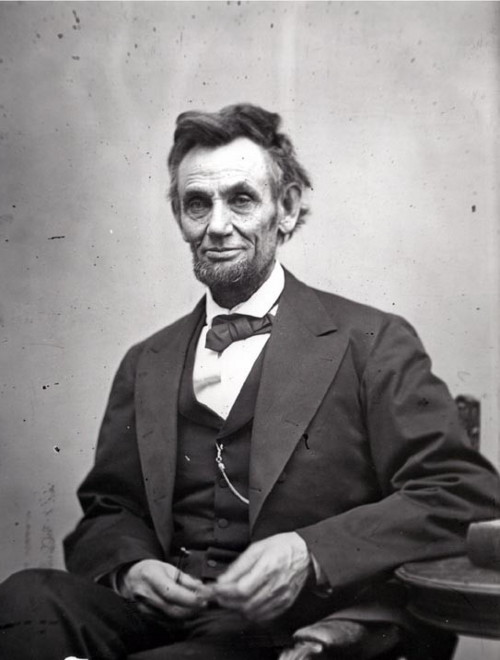
Excuse us for living, but it would be more than naïve to think that John Fitzgerald Kennedy belonged solely to our generation, coming of age in the 1960’s. As with Lincoln, his Secretary of War Edwin M. Stanton’s famous words at his deathbed are equally appropriate for Kennedy; “Now he belongs to the ages.”
In our day after Kennedy’s assassination, the respected columnist Mary McGrory was in line at the viewing at the Capitol Rotunda. She leaned over to Daniel Patrick Moynihan, at that time Assistant Secretary of Labor, and said, “We will never laugh again.” Moynihan responded, “We will laugh again, but we will never be young again.” He was prescient, hinting at our unrequited idealism to come in the years ahead.
On this 50th anniversary of Kennedy’s assassination, November 22, 1963, we are bombarded with TV news programs and documentaries which, for the most part, are quite good. And at least five new books on Kennedy have had timely publication dates. As one would expect, these efforts have concentrated on JFK’s accomplishments and greatness as President, his legacy and influence, and especially the alternative conspiracy theories to the one shooter conclusion of the Warren Commission Report. Rather, here I want to address the Kennedy experience of our unrequited idealism. (For a fast read, skip down to “What does JFK’s death mean to us?” below.)
I dare say our generation would stake a claim to the strongest of emotional ties. He was elected President in November, 1960, at the outset of our freshman year of high school. We witnessed his campaign characterized by “vigor” which made us believe he would be a new kind of President with new ideas at home and strength abroad. Perhaps he was the candidate best suited to stand up to the Soviet Union and protect America’s preeminence in the world.
And it was during JFK’s brief 1000 days in office, while we went about our high school careers, that he was that kind of leader. – -Energetic, far reaching, and, in the end, tragic. His qualities of idealistic leadership had a great impact on our high school years. We unknowingly went about emulating his example of service and achievement in our smaller, lesser school goals and activities that marked these precious years.
While we went about our lives, our President gave an outstanding inaugural address. His famous, eloquent words, with the help of his speech writer, Theodore Sorensen, challenged us to serve our country and promised that America would stand up to any foe to defend liberty. We were taken by his lofty, confident air.
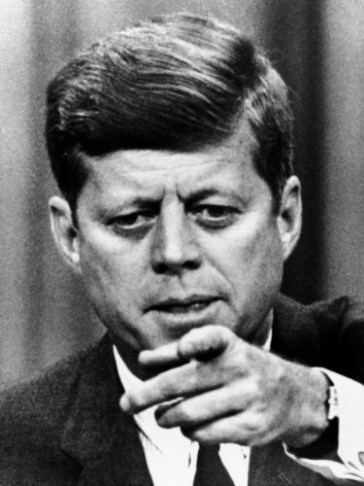
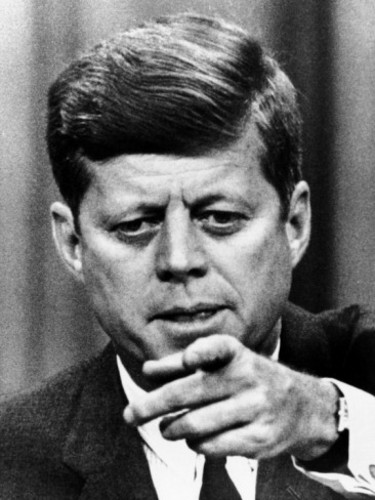
John F. Kennedy was the first President to institutionalize the televised press conference. The press conferences, credited to be every two weeks, in actuality averaged every 16 days. –quite a record.

John Kennedy was the first President to recognize the power of TV to communicate with the American people. He was our first “TV President.”
Yet, when I read of the modest agenda he had in mind for his administration of lowering unemployment, addressing US-Soviet relations, and progressing on civil rights, what followed in the brief time he had in office was staggering. – -The Bay of Pigs invasion of Cuba, Joint Session of Congress in which he challenged us to go to the moon and back in this decade, the Cuban Missile Crisis, the Civil Rights movement/protests/integration/proposed bill, US-Soviet relations/the Berlin Wall going up/ the Nuclear Test Ban Treaty, and the beginning of serious US troop deployment to South Vietnam, to just hit the lows and highs of those years.
It all ended so abruptly in beautiful weather in Dallas, Texas, on that Friday afternoon in November. Our recollection from high school was hearing the news on the “PA System,” public address system, the infamous speaker box in each classroom in our high school from which the principal always spoke to us. – The shocking words coming from the principal, the classroom teachers trying best they could to talk to us, some student screams and crying and a few collapsing onto the hallway floor. “Would there be school activities, the Saturday football game? pondered our principal. “Of course not!” I audaciously counseled the principal. We knew the gravity of the moment. He was our President.
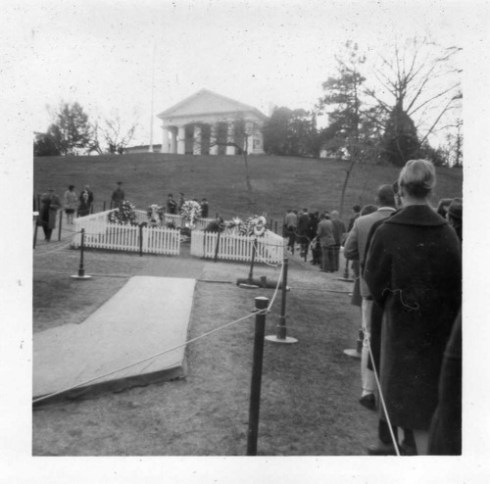
This photo was taken by me, Saturday, March 21, 1964, on our Senior Trip to Washington, D.C. According to the itinerary, around noon we visited JFK’s crudely erected grave-site at Arlington National Cemetery, just below Arlington House (the Curtis-Lee mansion).

Again, this photo was taken by me, March, 1964. (See the above caption) A close up of JFK’s grave, marked by the eternal flame. To the left is a headstone for Patrick Kennedy who died in infancy. As student council president, I placed a wreath at President Kennedy’s grave on behalf of our Class of 1964.
There was the great sorrow and heavy doubt. Would the hopes and promises he kindled be realized? Images of him, his family, his White House were still vivid in our minds. I remember we ran a huge clothing drive in his memory for the poverty stricken Appalachia area in early 1964. We visited his grave at Arlington National Cemetery during our senior trip to Washington, D.C., March, 1964. But then after graduation many of us were off to college or jobs. Life went on, as they say. We did not live in despair of our lost President but more in hope that all he stood for had not died with him. A few of us even went to the 1964 Democratic Convention conveniently held in Atlantic City, New Jersey, and got to brush elbows, literally (no joke!), with Robert Kennedy in the makeshift Boardwalk museum tribute to his brother.
During our college years we could point to President Lyndon Johnson’s “Great Society” programs including Medicare, Medicaid, environmental protection, aid to education, the “War on Poverty” legislation, and more. To these great social programs, LBJ added his impressive civil rights record, fulfilling the work begun by JFK, with passage of the Civil Rights Act of 1964 and the Voting Rights Act of 1965.
But the vestiges of hope were already waning with the race riots of the mid-1960’s, escalating into cities burning in 1967 and 1968. Then there were the increasing unrest and anti-war protests with the Vietnam commitment of troops after the 1964 Gulf of Tonkin Resolution, culminating in the troop buildups of 1967 and 1968, eventually reaching over 550,00 American troops. (We cannot forget the tumultuous, explosive 1968 Democratic Convention in Chicago!) – -Some of us were eventually caught up in the draft or volunteered to serve in Vietnam War. But then in that spring of our senior year of college in 1968 came the assassination of Martin Luther King Jr. that April. Followed by the assassination of Robert F. Kennedy in June of 1968, immediately after our college graduation, it seemed that all hope of any JFK dream, the idealism, had died itself. RFK was our last hope. Robert Kennedy always ended his stump speeches running for the 1968 Democratic nomination for President with the words loosely borrowed from George Bernard Shaw (that were a favorite of his brother Jack as well!): “Some men see things as they are and say, ‘Why?’ I dream of things that never were and say, ‘Why not?’” Those words seemed to have kept John Kennedy’s idealism alive until Robert Kennedy was no more.
What does JFK’s death mean to us? I think the emotions of our generation, in particular, are inextricably tied to JFK by our unrequited idealism. I am not speaking just of our hopes in and for him unrealized, unfulfilled, though that part certainly cannot be denied. But I speak of our own failed idealism as a result of experiencing our loss and our disappointment and our discouragement in the years which followed. What I am getting at is that as a result of the loss of JFK and the aftermath, we did not fulfill our potential to serve. To the contrary, we were driven to withdraw into our own field of selfish fulfillment.
Oh, you can add further disparagement: there was Teddy Kennedy’s tragic escapade on Chappaquiddick Island, July, 1969; the Kent State massacre of four college students by the Ohio National Guard in 1970; the Watergate break-in, 1972, and cover-up; the first resignation of a President with the departure of Richard Nixon in 1974.
But in my opinion, the dream that John Kennedy represented died with Robert Kennedy and with him our incentive to work for that ideal held high for us, symbolized for us, in a fantasized spot called “Camelot.”
Edward M. Kennedy tried to rekindle the flame when he challenged President Carter in the 1980 Presidential Primary. If you have any doubt, hear his words at the 1980 Democratic Convention conceding to Carter: “For all those whose cares have been our concern, the work goes on, the cause endures, the hope still lives, and the dream shall never die.” The words were inspiringly delivered. However, to take them to heart seemed to deny that the dream had died. To prove the point, shortly after in 1982 Ted Kennedy announced he would not run in the 1984 Presidential Election. He acknowledged that the Senate was a fully satisfying career.
Fast forward to the 2004 Presidential Election and Teddy sought to “pass on the Kennedy chalice” to John Kerry, his fellow Senator from Massachusetts. That having failed, Teddy, joined by Caroline Kennedy, endorsed Barack Obama in the 2008 campaign. Teddy was hoping through Obama to restore the “fading luster of Camelot.” On the other hand, Obama needed Teddy’s credibility within the Democratic Party to win the nomination. It was clear to the honest broker that the JFK promise had long faded.

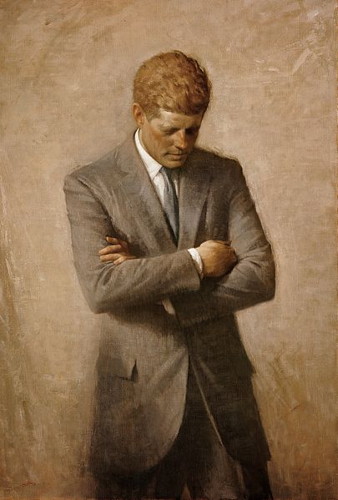
White House “Oil Portrait of John F. Kennedy,” 1970, by Aaron Shikler. Do you like it? I do. It’s supposed to demonstrate our grief for the loss of our President & acknowledgement of the time in office he was denied. But I think John F. Kennedy deserves a traditional presidential portrait to represent his legacy & achievements while in office during the time he did have in the White House.
Excuse us for living, but we know there are many exceptions to our generation’s general turning away from national service. In fact, you know a prominent one; Bill Clinton! – -High School Class of 1964 and college Class of 1968!!!
Comments: Please!
Sources:
TV: “JFK: American Experience,” part I & II, PBS, Nov. 11 & 12, 2013
“Sunday Morning,” CBS, Nov. 17, 2013
Books: The Making of the President 1960, 1961, by Theodore White
Kennedy, 1965, by Theodore Sorensen
A Thousand Days, 1965, by Arthur M. Schlesinger, Jr.
The Death of a President, 1967, by William Manchester
Jack Kennedy: Elusive Hero, 2011, by Chris Matthews
Robert Kennedy & His Times, 1978, by Arthur M. Schlesinger, Jr.
Robert Kennedy: His Life, 2000, by Evan Thomas
Last Lion, 2009, by Boston Globe writers
True Compass, 2009, by Edward M. Kennedy
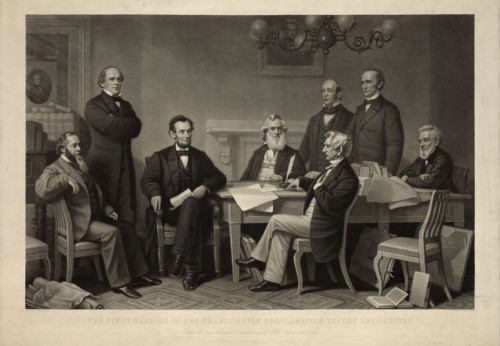
Team of Rivals, 2005, by Doris Kearns Goodwin
Online: Wikipedia, wikipedia.org






























 Excuse Us for Living
“1912” The Movie!
An Idea for Another History Movie,
My Letter to Author Doris Kearns Goodwin
&
A Note from Doris!
Excuse us for living, but many of us from time to time wish we could get word to someone famous or prominent. It might be a celebrity, perhaps an author, maybe a politician. Quick! Would somebody please call Spielberg! For the last nine years I have wanted to contact Steven Spielberg for a movie idea perfect for the 2012 one-hundredth anniversary of the 1912 Presidential Election. Right. Try to contact him! Any hope for a film by that anniversary came & went, obviously.
It all started in the early 2000’s when I read “The Warrior And The Priest: Woodrow Wilson and Theodore Roosevelt,” by the prominent John Milton Cooper, Jr., 1983. It’s a very academic discussion of the Progressive Era & the differences on the major issues of those times between TR & Wilson; regulating big business monopolies, eliminating corrupt political machines and bosses, purifying foods and drugs, the labor movement and working hours, and so much more. But what fascinated me were the images of “The Warrior” for Roosevelt and “The Priest” for Wilson, which I transformed into the title, “The Moose And The Professor.” (For TR a take-off of his 1912 Bull Moose Party. For Wilson calling on his image as a professor at Princeton.) – – “What a neat title for a movie,” I thought!
And then came along James Chace’s little book, “1912,” which really got my juices flowing as to my movie idea. I was on top of things this time and read the book when it was first published in 2004. The book had no subtitle, but the jacket cover said it all, “Wilson, Roosevelt, Taft, & Debs – – The Election That Changed the Country.” It was all about this unique election of 1912. The sitting Republican President, William Howard Taft, was being challenged by his predecessor, Theodore Roosevelt, who had hand-picked Taft to succeed him! Added to these two Presidents in what became a spectacle of candidates were the Democratic standard bearer, Woodrow Wilson, Governor of New Jersey, and the Socialist candidate, Eugene Debs, the radical labor leader.
Teddy Roosevelt (undated photo) loved to campaign from the back of a train. As President he also toured the nation by train to the west coast & back.
Woodrow Wilson (undated photo) also campaigned from the last car of a train. He famously used this practice as President to gain favor from the American people for his League of Nations.
I brought plenty of background to my enthusiasm as a retired history teacher. It all started with Woodrow Wilson as my hero back in my college years as a history major at Rutgers. And then my great appreciation grew over the years for Theodore Roosevelt through my readings on both these giants of the Progressive Era. I had already read H. W. Brands’ 1997 book, “TR: The Last Romantic,” and August Heckscher’s 1991 “bible” on the subject, “Woodrow Wilson.” Over the years, I continued my reading about TR & Wilson with the many prominent books previously published & new books that came out. Putting these influences together had me fantasizing all the more with the movie title, “The Moose And The Professor.” – -Either that title or a more traditional choice, “1912.” – – I still prefer “The Moose And The Professor.” But can’t you visualize this?
Casting
Tom Hanks as Theodore Roosevelt: Besides working with Spielberg on numerous films, Tom Hanks’ list of starring roles & awards is seemingly endless. In particular, his portrayal of the eccentric character, Professor Goldthwaite Higginson Dorr, in The Ladykillers, 2004, is one step away from doing a great TR!
John Goodman as President William Howard Taft: To John Goodman’s considerable girth to match that of Taft, his list of distinguished & prominent roles is considerable, more recently The Artist & Argo.
Johnny Depp as Eugene Debs: Known for his lesser, eccentric character roles as well as his blockbusters, from Edward Scissorhands to his Pirates of the Caribbean series, Johnny Depp would capture the strange, dark nature of the radical Eugene Debs.
Kevin Klein as Woodrow Wilson: Kevin Klein’s maturing look added to his natural demeanor would easily slide him into the part of the professorial Woodrow Wilson. To his long list of hit movies & awards, his portrayal of the President in the movie, Dave, nominates him for this part!
These were my castings over the years. And like so many hair-brained schemes, the year 2012 came & went and my idea dwindled into a by-passed fantasy, Then, along came Doris Kearns Goodwin’s “Team of Rivals: The Political Genius of Abraham Lincoln,” 2005, collaborating with Steven Spielberg on the movie, Lincoln, in 2012. As if that were not enough to get my juices going again with hopes of a movie, “1912,” or “The Moose And The Professor,” along came A. Scott Berg’s book, “Wilson,” this past September 10, 2013. Accurate or not, word came out that Leonardo DiCaprio was interested in the book as a possible movie! I knew another Doris Kearns Goodwin book was about to come out any week on TR and Taft so I started to go around saying, “No, no,” to a Wilson movie, & “Yes, yes,” to a movie about the 1912 Election!!! And, sure enough, on November 5, 2013, the much awaited, “The Bully Pulpit: Theodore Roosevelt, William Howard Taft, and the Golden Age of Journalism,” by Doris Kearns Goodwin, was officially published!!! And, as if that were not enough to drive me “bananas,” in an interview with the author herself in the Time Magazine, dated November 18, 2013, the interviewer, Belinda Luscombe, mentions that Doris Kearns Goodwin sold the film option for her new book to none other than Steven Spielberg!!! In the course of the interview, Doris does not deny it.
Now this is too good to be true for me! A. Scott Berg’s book, “Wilson,” coming together with Doris Kearns Goodwin’s Book, “The Bully Pulpit”!!!!!!!!! It’s like a dream come true! “Doris, please, please, call Spielberg!!!!” Just as with the movie, “Lincoln,” & the 13th Amendment being the center piece, so there must be a core to the movie “1912,” or “The Moose And The Professor.” (I can already tell by the sound in my ears typing this that “The Moose…” title would NOT fly with the “suits” in Hollywood! They would probably choose the more conventional title, “1912.” But that’s OK with me!)
Movie Synopsis
The monumental significance of the 1912 Presidential Election was that the sitting President, Taft, and the former President, Roosevelt, split the Republican vote, thus assuring a Democratic, Wilson victory. Not only would the combined Republican vote have defeated Wilson, but TR’s vote total was bigger than Taft’s!
Teddy Roosevelt: TR’s keeping his pledge, with regret, not to run again and anointing Taft as his successor. TR going off on the African safari only to return with great dissatisfaction over Taft’s positions and performance as President. TR’s fight to take nomination from Taft at the 1912 Chicago Republican Convention, only to be rejected & accept the nomination from the Progressive Party, dubbed the Bull Moose Party. And, despite the October 14, 1912 assassination attempt on TR in Milwaukee, lodging a bullet in his rib, without losing a step, TR moves on & delivers his planned address to the cheers of the waiting audience.
Woodrow Wilson: A scene on the Princeton University campus with Wilson as Princeton’s President, having just been elected Governor of New Jersey. Wilson confronting the political bosses of the State. Wilson’s rapid passage of his Progressive reform agenda by the New Jersey Legislature in his first months in office. Then after barely two years in office, Wilson off on the 1912 presidential campaign trail.
Can you see it all???!!! – – TR’s Progressive programs that he called the “New Nationalism” vs. Wilson’s Progressive programs that he called the “New Freedom”! – – And the obvious comparison that little has changed from the politics of 1912 to our present day political scene: with the Republican Party entrenched by the conservatives at odds with Party moderates; & the Democratic Party with its “big tent,” inclusive public appeal, nominating liberals attempting to run as moderates.
My Letter
“Quick! Call Spielberg! Can you, Doris?” Well, have you ever tried to contact a prominent person? The logical way to contact an author is through his/her publisher. Now-a-days, you can also leave a message on the author’s website. But in either case, your message is at the mercy of a staffer to get through to the real person. Ah, but one night shortly after her book launch, there was Doris Kearns Goodwin on Charlie Rose’ PBS show which airs each weekday night at 11:00 PM in the New York City area. What a feast of an interview, largely about her new book! And wouldn’t you know, but in the course of conversation, Doris mentioned that she lives in Concord, Massachusetts! That’s all I needed to hear to send her a letter: Doris Kearns Goodwin, Concord, Massachusetts, 01742. And so I did. The content that appears above is, for the most part, the letter I sent to her minus my personal remarks about her many books and her career. She is the gracious, open spirited person we have seen over the years on TV news programs from “Meet the Press” to “Morning Joe.” And what follows is her kind note that I received a few days after Thanksgiving, just two weeks after I sent her my letter. (And she has been intensely “on the road,” appearing on talk shows and news programs plugging her new book!)
Monday, October 7, 2013 photo of Doris Kearns Goodwin in her home in Concord, Massachusetts.
Doris’s Note
Excuse us for living, but sometimes you just “have to do what you have to do.” And when Steven Spielberg turns Doris Kearns Goodwin’s “The Bully Pulpit” into a movie, I know not what he will title the film. But I would not be surprised if the crux of his movie is all about the 1912 Presidential Election.
Comments: Please!
25 Comments
Posted in Book Reviews, Commentary, History